


Proscreen
By Tom F. Stickney, Director of Operations
Have you ever tried to “work on” your swing only to find that you cannot get your body to put itself into the “look” of the position you are trying to accomplish? Do you ever look at some of your playing partners or people on the range and noticed them moving into funky positions or even into an odd-looking motion? If so, you have noticed the body trying to work its way into a position that it cannot do physiologically, thus a weird modification ensues. It’s these modifications that give people “different” looking swings and contorts their bodies into positions that just don’t look comfortable or fundamentally sound at all.
Thankfully there are tests to figure out how a person can move their body and show what limitations they have on the mobility and stability side. These functional movement screens have been used for decades within other sports, but they have just been introduced to the golfing world by organizations like TPI and Kinetisense. It’s these screens that help the golf instructor to truly understand what their student can do physiologically and from there what they need to do in the gym or within their golf swing to work “around” these bodily issues.
One of the newest trends in golf is using 3-D motion analysis and AI together to see things that our eyes cannot see. It’s technology like this that is moving golf instruction forward and helping students of all levels swing in a way that best suits their physiology. When functional movement is coupled with the right fundamentals of the golf swing success can occur and these weird looking motions will become a thing of the past.
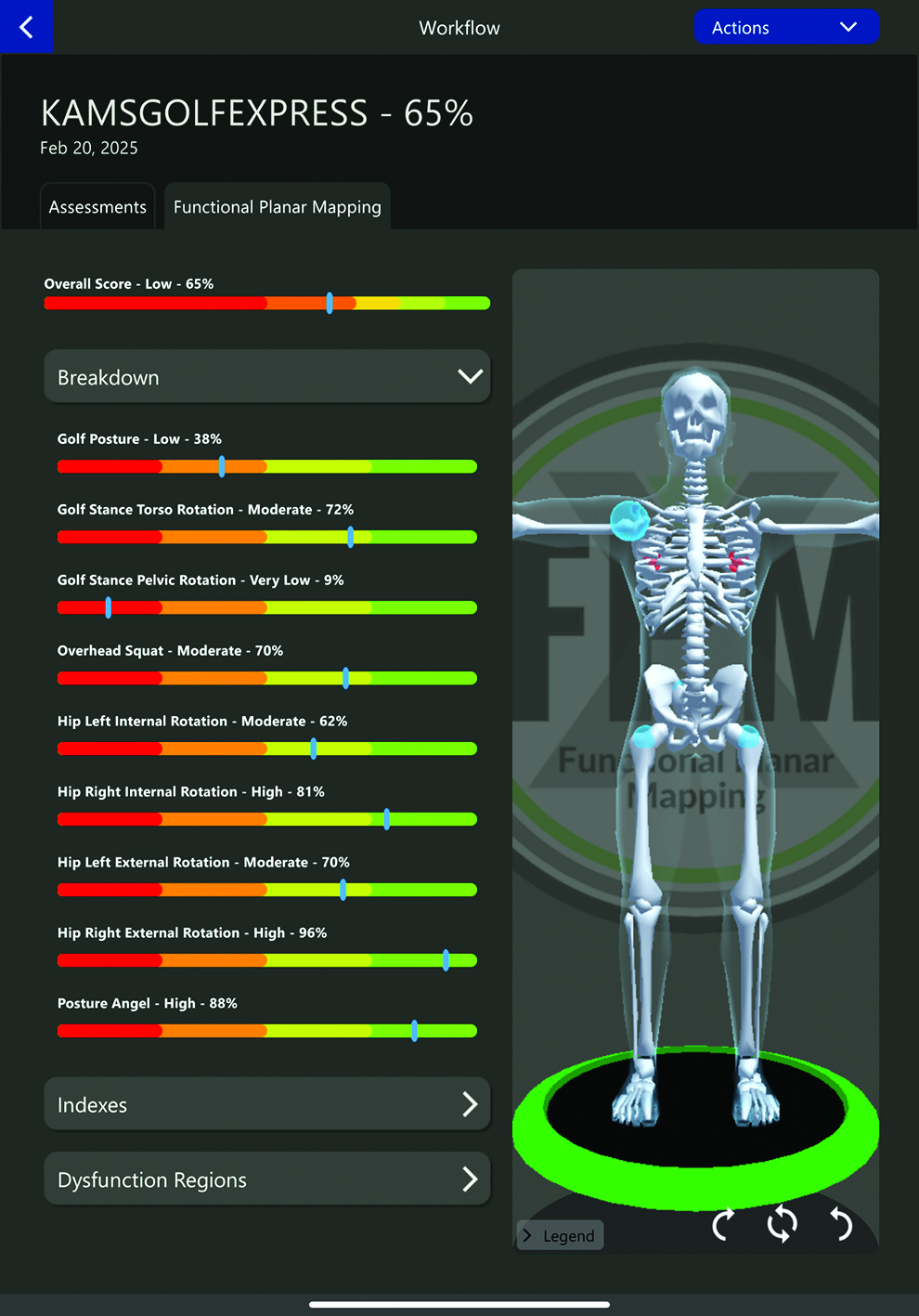
Kinetisense has created a screening product called Proscreen AI that will map the motions of the body and show its contraindications and this I feel is the next big wave in golf instruction.
This is a sample report of a screen that I did on a golfer the other day … he was complaining of a lack of distance and an over the top transition so we first tested him to see what issues, if any, his body had that would cause these types of issues. What we saw was an inability to move his hips rotationally and more specifically into the backswing position. Whenever a person has this type of imbalance the arms will tend to lift to the top because the hips and shoulders don’t turn enough and this causes over the top transitions and lack of distance, etc.
The best thing about this type of technology is that it finally gives us a true understanding of how and what a person can do from the physical side and from there the golf instructor has a better chance to build a swing around these disfunctions. However, if you don’t test these things you will never know what your overall limitations are personally and this will hamper your progress on the lesson tee.
If you would like more information on how you can get yourself and your golf swing tested to see what limitations you might have physiologically please email [email protected].